
The challenge
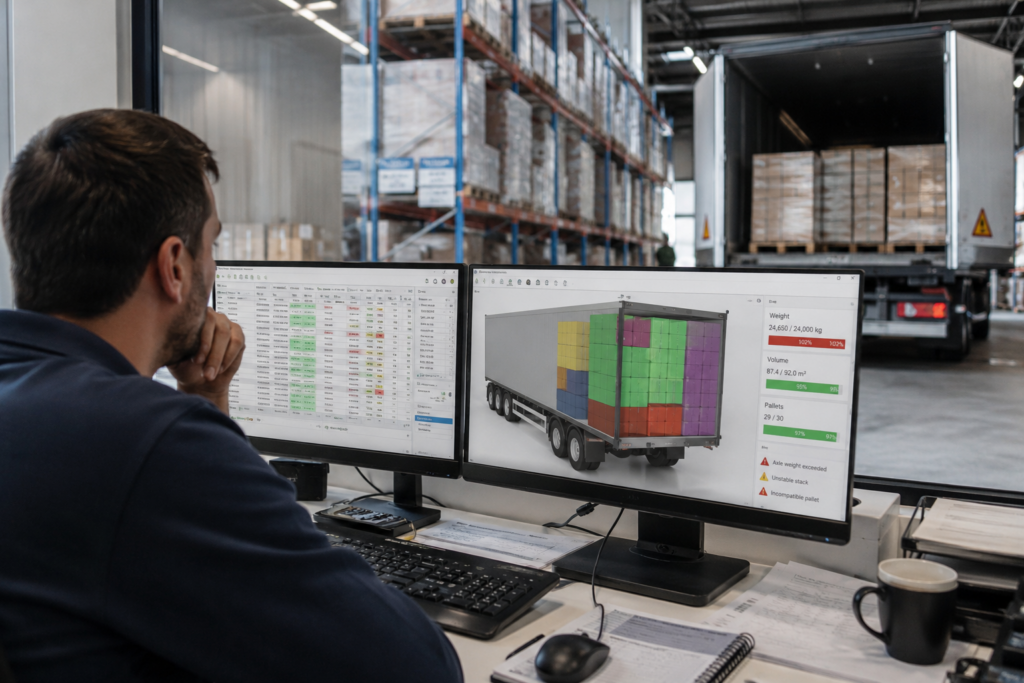
Many logistics and warehouse operations still rely heavily on manual adjustments when planning truck loads. Even when planning tools are available, they often lack the flexibility to incorporate real-world business rules, resulting in up to 90% of load proposals requiring corrections by planners.
This leads to significant inefficiencies: planners spend valuable time tweaking load configurations, cognitive load is high, and consistent optimization becomes nearly impossible at scale. At the same time, there is no truly out-of-the-box solution that can handle the complexity of constraints such as weight distribution, stacking rules, pallet compatibility, and trailer-specific limitations in a flexible, transparent way.
Our solution
At its core, our engine combines:
- Advanced optimization algorithms capable of evaluating thousands of configurations per second
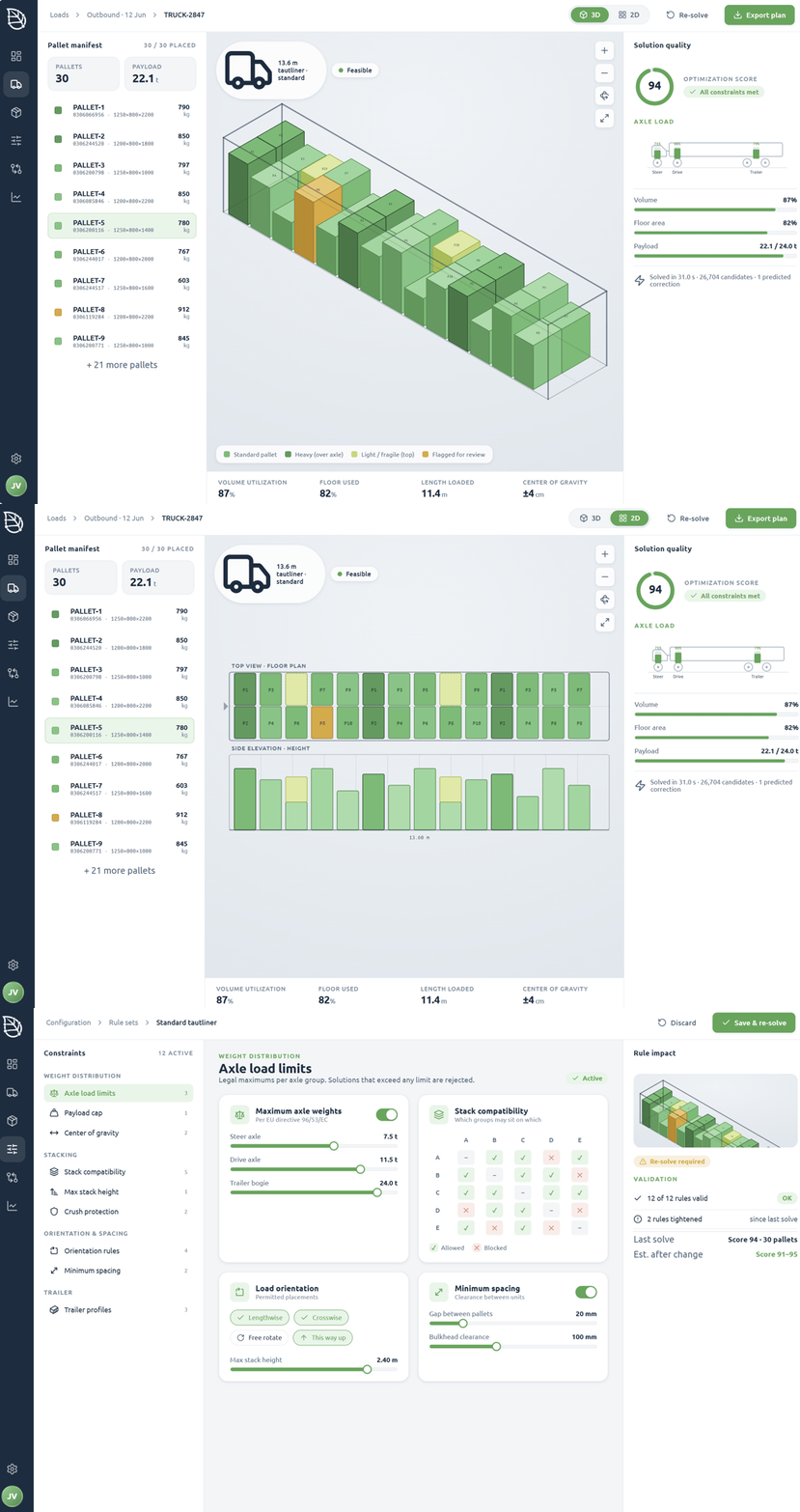
- Customizable rules and constraints, such as axle loads, pallet orientation, stackability, and spatial limits
- Dynamic rule management, allowing businesses to easily adapt to new operational requirements
- Optional machine learning enhancements, learning from historical corrections to improve future solutions
Intelligence meets integration
In addition, the solution is designed for seamless integration into existing ecosystems:
- It can ingest data directly from WMS systems
- It can output optimized loading plans to downstream tools or execution systems
- It fits within existing operational workflows without disrupting current processes
Flexibility through rules and constraints
One of the key differentiators is the ability to model real-life complexity through rules:
- Weight distribution constraints (e.g. axle loads)
- Pallet compatibility and stacking rules
- Minimum and maximum spacing between loads
- Orientation restrictions per product type
- Trailer-specific configurations (different sizes, layouts, and constraints)
Unlike traditional solutions, these rules are not fixed—they can be tweaked, adjusted, or removed dynamically. This means the system evolves alongside the business, supporting new products, packaging types, or transport modes without requiring a complete redesign.
The end result
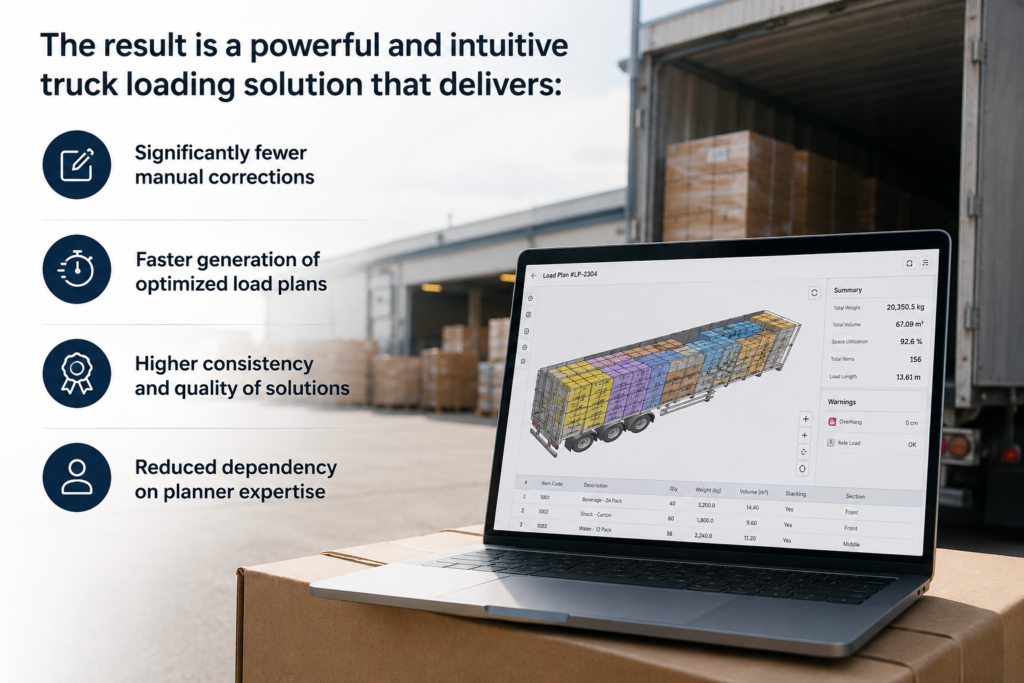
The result is a powerful and intuitive truck loading solution that delivers:
- Significantly fewer manual corrections
- Faster generation of optimized load plans
- Higher consistency and quality of solutions
- Reduced dependency on planner expertise
The user interface
From a user perspective, the experience is just as important as the performance. The solution includes a user-friendly interface that allows planners to:
- Visualize truck configurations in 2D or 3D
- Interactively explore loading scenarios
- Adjust or override rules when needed
- Quickly understand why a solution was generated
This combination of speed, flexibility, and usability transforms truck loading from a manual, error-prone task into a scalable, data-driven process.